
Applications
Designed for elemental screening against RoHS and halogen-free requirements with Mapping, restricted-element screening in toys and everyday consumer products, and alloy composition analysis. The original site identifies designated CN-RoHS certification laboratories and central laboratories of large corporate groups as key applications.
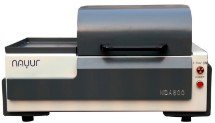
Optics and measurement functions
- Testing without disassembly: patented optics and precise spot positioning provide a minimum irradiation spot diameter of 0.5 mm for direct measurement of complex samples.
- Mixed-sample testing and area scanning: the original specification describes a 4 mm × 4 mm square spot used with a 0.5 mm spot to scan circuit boards and other complex samples. Its statement of conformity with Chinese national standards requires confirmation against the applicable standard and test conditions.
- 16 composite filters: provide configurations for different complex samples.
- Automatic Mapping: enables area scanning.
- Radiation shielding: a labyrinth shielding structure. Actual radiation safety depends on equipment acceptance, applicable requirements and correct operation.
- Operating design: the instrument design considers ergonomics and measurement convenience.
Analytical methods and software
Methods include a fundamental parameter method based on a Monte Carlo calculation model, an empirical coefficient method and a theoretical alpha coefficient method.
Software functions include:
- Analysis of Pb, Hg, Cd, TCr (total chromium), TBr (total bromine) and Cl for environmental screening.
- Material analysis of metals and inorganic non-metallic materials, excluding polymers, over the S–U elemental range.
- S–U elemental content analysis in polymers and other organic materials.
- Customized analytical reports, output and printing; result storage, retrieval and statistics.
- Multilayer coating thickness measurement.
- On-Line real-time technical support and operator training.
Built-in standard calibration curves cover basic materials used in EU-RoHS and CHINA-RoHS product certification. An open calibration platform allows factories to develop curves for their specific materials. Operator and engineer menus separate routine measurement from parameter management.
Equipment and options
| Item | Original specification |
|---|---|
| Detector | Electrically cooled SDD silicon drift semiconductor detector |
| X-ray tube | Side-window molybdenum (Mo) target tube |
| Filters | 16 composite filters as standard |
| Collimators | Φ0.5 mm, Φ1 mm, Φ3 mm and Φ4 mm |
| Scanning | Automatic Mapping and mixed-sample testing |
| Calibration | Built-in standard curves and open custom calibration platform |
| Access levels | Operator and engineer |
The original feature list marks On-Line technical support as optional, while the main configuration also lists the platform. Confirm the supplied configuration. Optional multilayer coating measurement uses Nayur's “influence weighting coefficient method.” The original specification states a maximum of 9 layers, including coating thickness measurement on plastic substrates.
Product specifications
| Item | Specification |
|---|---|
| Name / model | XRF spectrometer / NDA500 |
| Input voltage | 220 ± 5 V / 50 Hz |
| Power consumption | ≤500 W |
| Ambient temperature | 15–30 °C |
| Ambient humidity | ≤80%, non-condensing |
| Instrument dimensions (L × W × H) | 900 × 500 × 440 mm |
| Sample chamber (L × W × H) | 430 × 380 × 120 mm |
| Instrument weight | Approximately 60 kg |
| Elemental range | Sulfur (S) to uranium (U) |
| Typical measurement time | 30 seconds for polymers; 30 seconds for copper matrices |
Limits of detection (LOD)
| Material | Published values |
|---|---|
| Polymer | Pb, Hg, TCr, TBr and Cd: each ≤5 mg/kg |
| Copper matrix | Pb: ≤50 mg/kg |
Precision: original notation requires confirmation
The original text defines precision as the standard deviation σ of 7 consecutive measurements, but then incorrectly labels the values LOD. The original numbers and labels are preserved below; they should not be treated as verified standard deviation specifications.
| Material | Values in the original “precision” section |
|---|---|
| Polymer (plastic) | LOD(Pb), LOD(Hg), LOD(TCr), LOD(TBr): each ≤15 mg/kg; LOD(Cd): ≤7 mg/kg |
| Copper matrix | LOD(Pb): ≤50 mg/kg |
Accuracy: systematic bias δ
| Material | Published values |
|---|---|
| Polymer | δ(Pb), δ(Hg), δ(TBr), δ(TCr): each ≤100 mg/kg; δ(Cd): ≤10 mg/kg |
| Copper matrix | δ(Pb): ≤150 mg/kg |
These specifications come from the original site. Sample matrices, measurement conditions, supplied equipment and acceptance criteria require confirmation. Interpret elemental screening results using the applicable testing method.